Chapter 11 of 16 · The great periods of history
Chapter 10. Dating an object, a text, a site
How a date is made: the order given by the layers, the measurement given by the material, and the margin that comes with every date.
Two ways of dating, and they do not answer the same question
Dating does not mean the same thing depending on what you are after. Establishing that one object is older than another is one operation; establishing that it is three thousand two hundred years old is another. The first gives an order, the second gives a number, and the means used have nothing in common.
The first is called relative dating. It ranks facts against one another, without attributing a date to them. It is old, robust, and rests on lines of reasoning that anyone can follow: what covers is later than what is covered, a text that speaks of a fact was written after that fact.
The second is called absolute dating. It attributes a number of years, with a margin of uncertainty. It requires instruments, a laboratory and calibrations, and for ancient periods it has only existed since the middle of the twentieth century. This chapter gives both, and it insists on what each of them cannot do.
The two datings, set facing each other
Relative dating
- It answers: what comes before, what comes after.
- It rests on the position of things in relation to one another.
- It requires no instrument, only rigorous and recorded observation.
- It applies everywhere, including to periods where no measurement is possible.
- It never gives a year, and it does not claim to.
Absolute dating
- It answers: how many years have gone by.
- It rests on a physical property of the material analysed.
- It requires a sample, a laboratory and a calibration.
- It applies only to certain materials and within certain age ranges.
- It always gives a value AND a margin, and the margin is part of the result.
The order given by the layers
Ground builds up by piling. What is deposited today covers what was deposited yesterday, and so on. A site occupied for a long time therefore carries a pile of layers, called strata, whose order reproduces that of time. It is the simplest and the most powerful principle in archaeology.
The Institut national de recherches archéologiques préventives gives its origin and its definition: stated as early as the seventeenth century by the Danish scholar Nicolas Sténon, known in English as Nicolas Steno, the stratigraphic approach consists in studying the superposition of geological layers (strata) in order to understand their succession and their relations. The same institute recalls that it only took hold among field researchers a hundred and fifty years later.
The example it cites is instructive. In the 1840s, following earthworks, a researcher discovers chipped stone tools and deduces their age from the depth at which they were buried. By establishing that these tools lay in the same layers as the bones of fossil animals, the method allows him, in the institute's words, to have the very great antiquity of man recognised for the first time.
What stratigraphy brings is therefore not a date, it is a PROOF OF ANTERIORITY. It was enough to establish that humans lived long before was believed, a century before any method could say how long before.
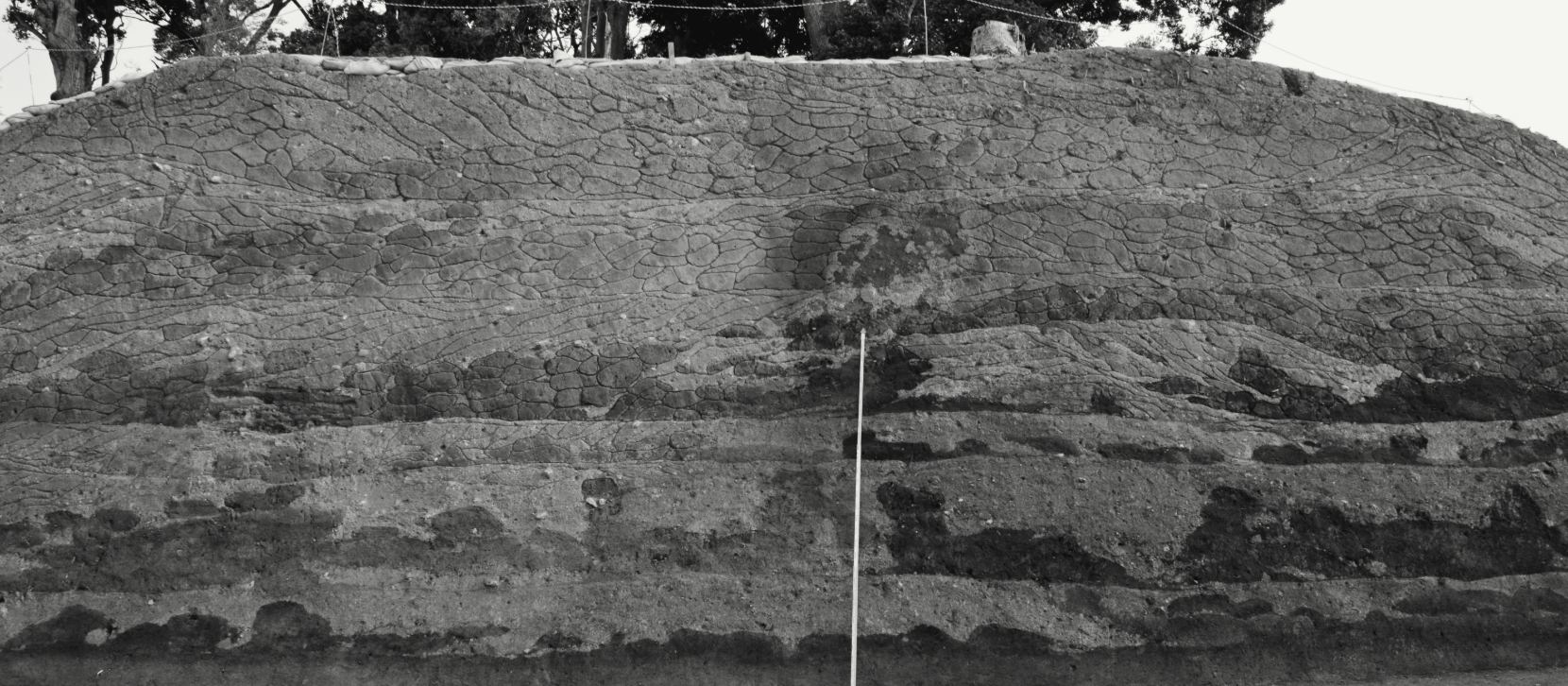
Reading a pile of layers
Four moves, in this order. The fourth is the one that gets forgotten, and it is the one that prevents false conclusions.
- Spot the order of deposit
The layer underneath was laid before the one above. That is true by construction, as long as nothing has moved. This simple observation already gives a complete chronology of the occupation of a place. - Spot what cuts and what is cut
A dug pit passes through layers older than itself. A wall that bites into a layer is later than that layer. Cutting relations give priorities that plain superposition does not give. - Record what each layer contains
Sherds, bones, charcoal, seeds. The contents then make it possible to attach the layer to a type of production known elsewhere, and sometimes to take a sample from it for absolute dating. - Look for what may have disturbed the pile
Animal burrows, ploughing, landslips, later foundations, fill brought in from elsewhere. A recent object fallen into an old layer falsely rejuvenates the whole layer if nobody notices it.
A layer can pass under another without being earlier than it: that is the case with tipped fill, with a collapse or with reworked ground. The principle of superposition is therefore not an automatic law, it is a working hypothesis that has to be checked in the field. It is also why an object found outside any context, picked up on the surface or bought, loses most of its scientific interest: without its layer, it no longer has a date.
The measurement given by the material
Some materials contain a clock. Carbon 14 is the best-known example. The Laboratoire de mesure du carbone 14, run jointly by several French public bodies, publishes its principle: this isotope is produced in the upper atmosphere by the interaction of cosmic particles with nitrogen, and it then enters the cycle of living things.
The decisive point is what happens at death. The laboratory puts it thus: when a living organism dies, it stops taking in carbon 14 and so the quantity present in that organism begins to decrease. The decrease follows a known law, so measuring what is left amounts to measuring the time elapsed since death.
The speed of that decrease is a physical constant, which the same laboratory gives: its half-life, also called radioactive period, is 5,730 years. After that span, half the initial carbon 14 is left; after twice that span, a quarter, and so on. The laboratory also states the limit of the method: after 4 or 5 half-life periods, very little 14C will be left, with a detection limit for this method of around 50 Ka, that is about fifty thousand years.
This limit draws the exact field of the method. It dates only what has lived: wood, charcoal, bone, seeds, textiles of plant or animal origin. It dates neither stone, nor metal, nor fired clay. And it does not go back beyond about fifty thousand years, which rules out most of early Prehistory.
| Question | Answer | What to remember from it |
|---|---|---|
| What exactly does it measure? | The time elapsed since the death of the organism the sample comes from | It dates the wood, not the piece of furniture: a tree felled long before use gives a date that is too old |
| What is the half-life of carbon 14? | 5,730 years | After 5,730 years half the initial carbon 14 is left, after about 11,460 years a quarter |
| How far back does it go? | About 50,000 years | The laboratory names two distinct facts: after four or five half-lives very little carbon 14 is left, and the detection limit of the method is around 50,000 years |
| What does it apply to? | To materials that come from living things: charcoal, wood, bone, seeds, fibres | The chipped stone itself is never dated: what is dated is what surrounds it in the layer |
Two ages for one measurement
A carbon 14 dating result is first written in a raw form: a number of years before present, with a margin. The Lascaux dossier defines this unit: "before present" counts years back from 1950, the present being fixed by convention at the date the method was invented. This number is not directly an age in calendar years, because the quantity of carbon 14 in the atmosphere has not been constant over the millennia. It therefore has to be converted, using curves established on materials whose age is known by other means.
The dossier of the ministère de la Culture on the dating of the figures of Lascaux gives the two forms side by side, which makes it a readable example. The measurements made in 1998 and 2002 by accelerator mass spectrometry give raw values of 18,600 years before present, to within 190, and 18,930, to within 230. Converted, they place the whole between twenty-three thousand five hundred and twenty-two thousand years before present.
The gap between the two forms comes close to four thousand years: depending on how the values are paired, it runs from three thousand to five thousand years. Somebody taking the raw value for a calendar age would therefore be wrong by close to four millennia, with a perfectly accurate figure in front of them. That is why a laboratory date is never copied out without its label.
The margin, for its part, is read as a bracket and not as an approximation. Writing 18,600 years before present to within 190 does not mean that the true value is 18,600: it means that it very probably lies within an interval of a few hundred years. A date without a margin is a date that has lost half its information.
Four dating traps, and their remedy
Dating the material instead of the object
Carbon 14 dates the death of the organism. A handle made from wood that was already old, or charcoal from the heart of a tree, gives an age older than the object. The remedy is to take the material as close as possible to the use being investigated.
Confusing the layer and its contents
An object can be much older than the layer it is found in, if it was kept, reused or moved. An old coin in a recent pit dates the pit by the most RECENT coin it contains, never the oldest.
Taking a single date for an established fact
One measurement is a result, not a conclusion. The Lascaux dossier shows a series of datings revised over more than sixty years. A date confirmed by several samples and several methods does not have the same standing as an isolated measurement.
Forgetting that a method has a field
Carbon 14 stops at around fifty thousand years and applies only to living matter. The older dates in the chapter on Prehistory, such as the traces of Homo sapiens around three hundred thousand years ago, necessarily come from other methods. A date with no method named cannot be checked.
What a date is worth, and how to write it
A historical date is a result, obtained by a means, with a margin. Written out in full, it carries all three: the value, the method, the uncertainty. That is what scientific publications do, and it is what allows a reader to know what they are holding.
Textbooks and timelines almost always reduce this information to the value alone, because a table with three columns is heavier than a number. The price of that simplification is real: every date ends up looking equally solid, whereas between the date of a signed treaty and the date of a prehistoric site there are several orders of magnitude of uncertainty.
The rule this book applies is modest and verifiable. When the source gives an interval, the interval is written. When it gives an "around", the "around" is kept. When it gives a century and not a year, a century is what is written. A date that cannot be given with its original precision is a date that is not given.
One last point, which is also the most encouraging. Absolute dating methods are less than a century old, and they keep improving. The ministère de la Culture describes the French installation serving heritage research, an accelerator mass spectrometer commissioned in 2004, able to analyse more than four thousand five hundred samples a year. The dates in this book are therefore the state of a knowledge at a date, and that date is written in the colophon of the volume.